An Introduction — Thinking About Looping
This is a book about live looping—a musical practice that attracts fierce advocates and determined skeptics in equal proportions.
For skeptics, looping can seem reductive: a practice that risks flattening musical nuance, encouraging predictability, and linear development. Some might see it as a shortcut that substitutes mechanical repetition for musical development, while others critique what they perceive as aesthetic clichés that have grown around loop-based performance. These concerns—whether philosophical, stylistic, or practical—form a crucial critique that advocates might consider.
For advocates, however, looping is about the power, joy, and discipline of working with repetition and patterned time, as well as the inherent creative possibilities and challenges that arise from it. Live looping is more than a technique—it becomes a way of thinking musically that emphasizes both structure and freedom. It is about the power and joy of building layered textures in real time, of listening closely and responding to patterns as they unfold, and of discovering subtle shifts in rhythm, harmony, and timbre that repetition can reveal. Looping allows performers to explore the interplay between anticipation and surprise. To its proponents, at its best, every repeated phrase is an opportunity: a chance to deepen expression, uncover hidden connections, and craft immersive sonic landscapes that reward careful attention. The practice demands focus, timing, and technological skill, yet offers a profound sense of satisfaction as small motifs can then transform into complex, dynamic musical structures.
Live Looping, Repetition, and Musical Thinking
The use of musical events that repeat over time is a defining feature of many musical traditions, spanning cultures and eras. Repetition lies at the heart of so many musical forms, such as rounds in folk music, call-and-response in blues and gospel, sonatas in classical music, trance-based musics, and, of course, minimalism.
This repetition establishes patterns of expectation that guide physical and imaginative engagement. Looping is the deliberate managing, shaping, and exploiting of these expectations through the intentional capture, configuration, reconfiguration, and deployment of repeated sonic material to serve creative ends.
Contemporary looping is also a practice with deep roots in experimental Western art music, including the work of Pierre Schaeffer, Terry Riley, Alvin Lucier, Pauline Oliveros, Gordon Mumma, Steve Reich, as well as collaborations by Robert Fripp and Brian Eno, and artists such as David Torn, Laurie Anderson, Pamela Z, and William Basinski. Looping has found love in popular music among artists like KT Tunstall, Imogen Heap, Reggie Watts, Ed Sheeran, St. Vincent, and many more.
In this book, we will explore technologies that make live looping possible. The advent of recording, and later the emergence of digital music, has enabled musicians to use technology to create forms of repetition that build on these familiar kernels of expectation, generating and organizing new forms of variety from them.
Technological developments inevitably shape the work musicians produce. For example, the invention of Western musical notation not only made music portable—allowing it to be learned independently of the composer—but also facilitated the creation of highly complex repeatable forms. A composed fugue, in this context, whose interweaving loops are subject to creative transformations, would be challenging to learn/explain without notation.
For practitioners of looping, the development of recording technology was equally transformative as the development of notation. The shift from ephemeral sound vibrations to a physically tangible medium enabled new forms of repetition, manipulation, and complexity. Many of these transformations are reflected in the software explored in this book. The first looper you will make recreates a foundational innovation: a fixed-length fragment of recorded sound—originally captured on tape—repeated to establish a pattern, which can then be modified through processes such as delay, slowing down, speeding up, reversal, and even ways to mimic the degradation of tape as it plays back.
The introduction of digital signal processing (DSP) further extended these possibilities. By decoupling sonic manipulation from the physical recording, musicians gained the ability to transform live input in real time, generating multiple, complex, interacting patterns that would be challenging, if not impossible, in the tape realm. This capacity for manipulation allows for the creation, organization, and repetition of sonic variety in entirely new ways.
Today, hardware loopers make multitracked recording accessible with remarkable ease, building directly on the principles of pattern and expectation described earlier. This book begins with emulation, before progressing to software-based tools that move beyond the metaphor of the physical tape fragment: offering new creative possibilities for the modern practitioner.
Building Live Loopers offers a practical framework for understanding how repetition organizes perception, but it also functions as a pedagogical tool: a way to cultivate programming habits, internalize concepts, and reflect on the tools with which we think (and create).
In the chapters that follow, we construct a series of patchers that begin with that simple looper modeled on the familiar metaphor of a length of recording tape. From there, we progressively introduce and examine more advanced forms of manipulation made possible by DSP. None of these patchers is intended to represent a linear progression toward a single definitive design: instead, each stands as a complete, usable tool—examples to serve as a point of understanding, as well as rich and open enough to provide a point of departure to support exploration, modification, and personal adaptation.
Every looper we build serves as an invitation to develop your own approach. Programming in Max rewards clarity and directness, and one of its most productive lessons is the value of simple solutions deployed thoughtfully.
Just as repetition provides a framework through which listeners form expectations in music, we have structured this book to operate in a similar manner. And just as composition often relies on tension, the process of approaching and solving a series of small programming or musical problems introduces its own form of tension—one that can be productive, clarifying, and even reassuring. By revisiting ideas, techniques, and patching strategies in various patching environments (Max, gen~, RNBO) throughout the text, we aim to cultivate familiarity and confidence while introducing you to different solutions for similar situations. Each recurrence is meant to guide your understanding of what comes next by building on what you have already encountered. Our hope is that this return—conceptually and pedagogically—creates a learning environment that mirrors the musical practice at the heart of the book: repetition as a means of grounding, orienting, and opening space for new possibilities.
How to Use This Book
This is a book about building loopers. So what do you need in order to begin?
We have designed this book to function equally well as a guide for self-directed study and as a resource in a classroom setting. You will not need an extensive mathematical background, nor do we assume prior experience with coding. We do, however, assume a basic familiarity with Max: enough to create and edit simple patches and to navigate the environment with reasonable comfort.
As you work through the chapters, there are several ways you might engage with the material and the accompanying patching examples:
- You can simply download the example patches and explore them as part of your own creative practice, without even reading the book.
- You can use the text as a guide to locate and modify specific components of a patcher, as each chapter sequentially steps through the addition of functions and features.
- Depending on your familiarity with Max/MSP and your own interests, you may pursue these ideas in a different order than the one we present. We have intentionally avoided building a single, “complete” looper. Instead, each chapter provides a fully functional variant that can serve as a starting point for your own investigation.
- Or, you may choose to “patch along”—individually or in a classroom—following the incremental construction of each patcher as a way to observe how an experienced Max programmer might frame, approach, and solve problems.
We encourage you to combine these approaches as needed, moving back and forth between text and examples, constructing the kinds of cognitive “loops” from which insight often emerges.
For readers new to Max, RNBO, M4L, or gen~, each chapter has been structured to minimize assumptions about technical expertise beyond what is stated above. When we introduce unfamiliar concepts or describe a technique that will recur throughout the text, we provide explanatory notes and guidance as to how to proceed. Our goal is to support you as you build fluency—whether this is your first encounter with these environments or a return prompted by new creative aims.
We will return frequently to the practice of building similar tools in different environments, exploring variations across Max, RNBO, and gen~. We have structured the chapters themselves as repeated approaches to explaining patchers, reinforcing the idea that programming is as much about habits of thought as it is about discrete technical skills.
We recognize that a “patch-along” format presents a practical challenge: it requires a clear view of the starting point, the intermediate steps, and the completed structure. To address this, the patches in most chapters are organized sequentially, with each step building directly from the previous one.
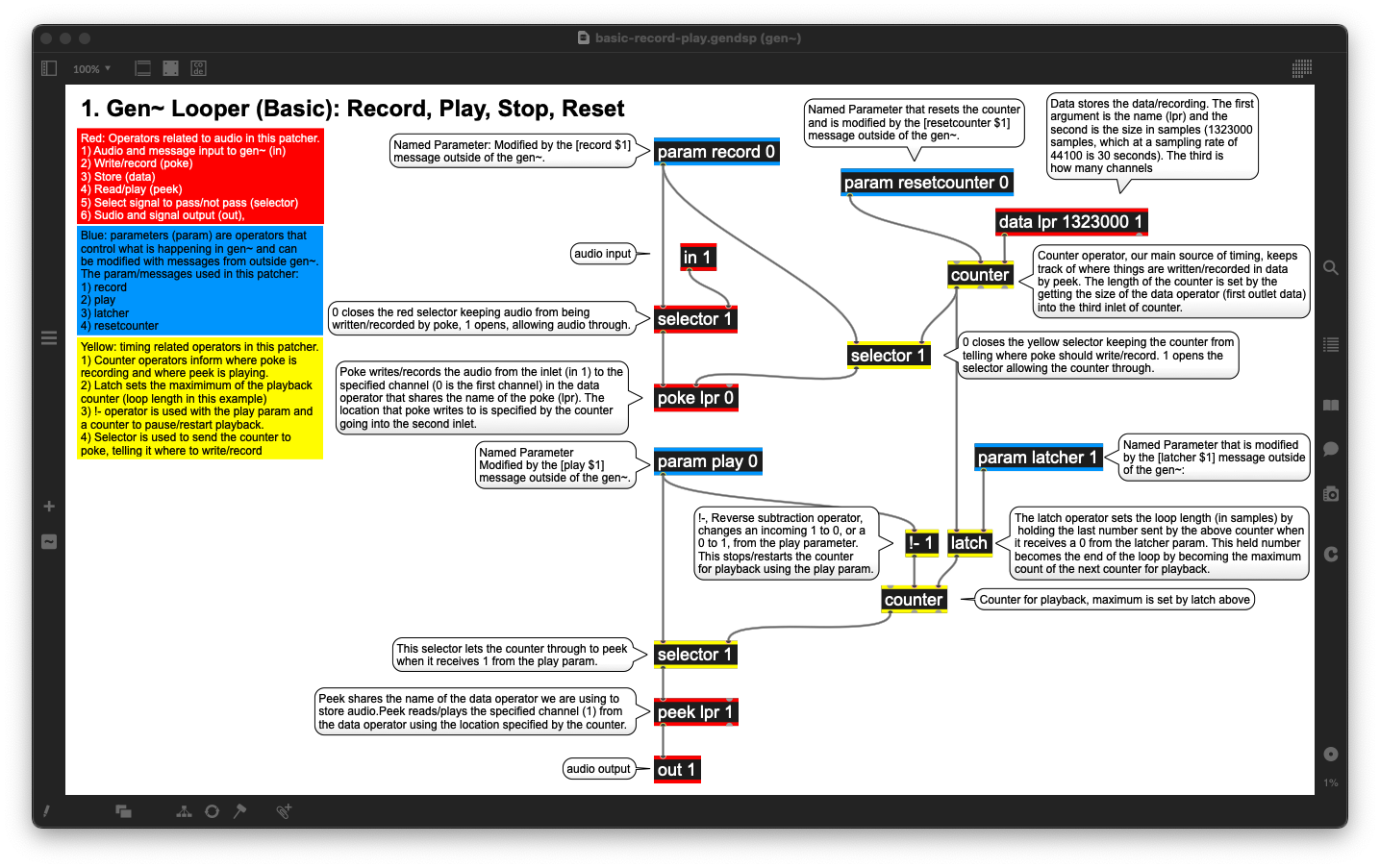
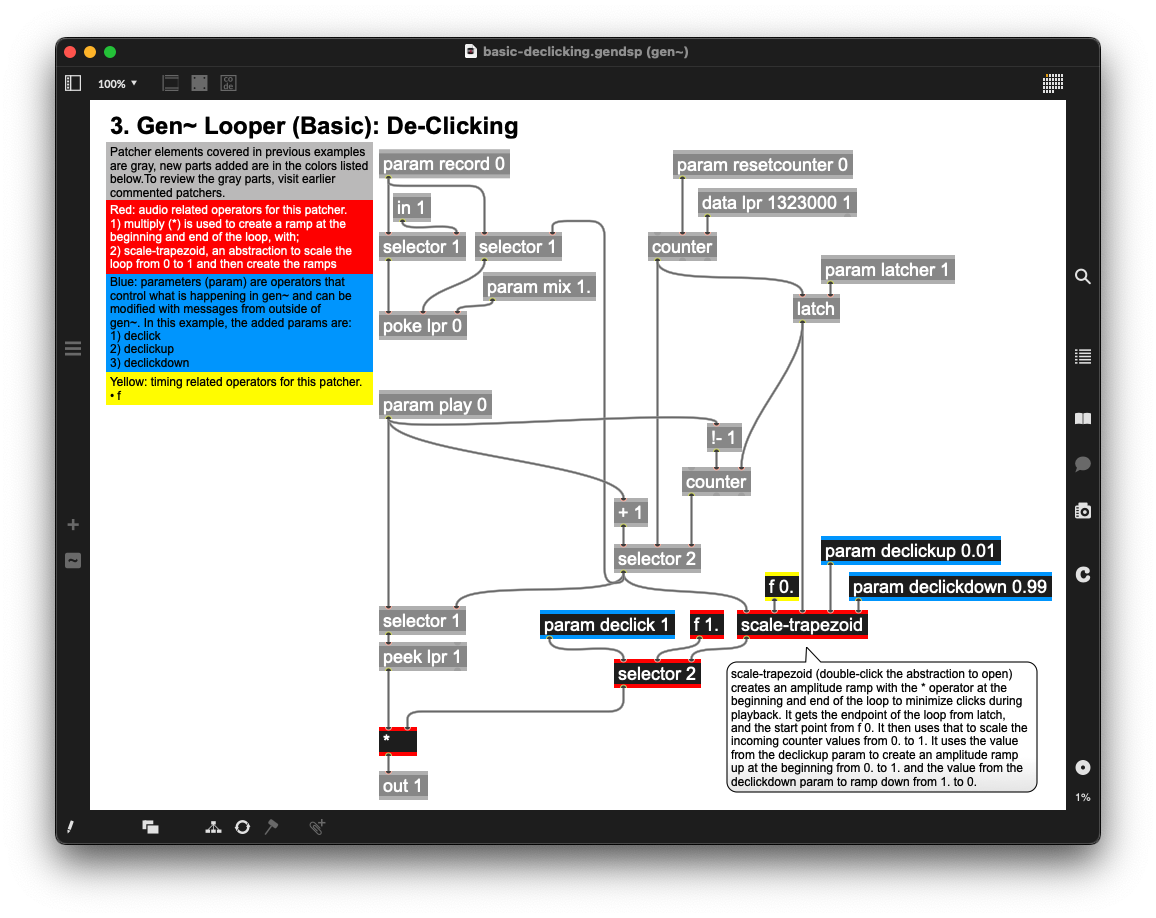
To make this process legible, we have color-coded the examples so that additions and changes are immediately visible. The color system is designed to highlight the functional roles of new objects or operators:
- Red indicates objects and operators related to audio-processing.
- Yellow highlights objects and operators related to timing.
- Blue marks objects and operators related to parameters that can be adjusted (either directly or via messages) to influence behavior inside the patcher.
- As you progress from step to step, only new elements will appear in the colors indicated above. Prior components will be either folded into a subpatcher or color-coded gray to help visualize what has changed, making it easier to “step backward” if you wish to trace the construction process.
By now, we hope you have a sense of our aims and the ways we have tried to make them visible to you as both a reader and a practitioner. Although you could simply download the patches and explore them on your own, we have invested considerable effort in creating a book that guides you step-by-step through the construction of Max patchers, highlighting how experienced programmers think, make decisions, and adjust their strategies. Our hope is that this process will help you become the next iteration of this practice: not only a user of patchers, but a creator of them. In doing so, you contribute to a growing community of artists, technologists, and educators who build their own tools.
Thank you for engaging with this work, whatever your intentions for its use may be. We hope that what follows will help you generate, repeat, and organize variety in your own creative practice.
Let's get started.